Explanation of Important Matters (Jūyō Jikō Setsumei) in Japan: A Checklist for Foreign Buyers
karmalegal-japan
Explanation of Important Matters (Jūyō Jikō Setsumei) in Japan: A Checklist for Foreign Buyers
If you’re buying a house or land in Japan—especially an akiya (vacant home)—you will likely receive a document called the Jūyō Jikō Setsumei (重要事項説明), often translated as the “Explanation of Important Matters.”
For foreign buyers, this is one of the most important steps in the entire purchase. It’s where many deal-breaking issues (road access, rebuilding restrictions, hidden risks, usage limits, etc.) are revealed—sometimes in Japanese legal terms that are easy to miss.
This article gives you a practical, plain-English checklist to review before you commit.
Note: This is general information, not legal advice. Every property is different, and you should get a professional review for any contract or disclosure documents.
What is the Jūyō Jikō Setsumei (Important Matters Explanation)?
In Japan, a licensed real estate professional explains key legal and practical facts about the property—often before the final contract signing. The explanation typically covers:
Legal restrictions on the land/building
Access roads and rebuilding eligibility
Infrastructure and utilities
Disaster risks and zoning
Known defects and management issues
Transaction conditions and special clauses
Think of it as Japan’s “disclosure + risk briefing” document.
Why foreign buyers should pay extra attention
Foreign buyers often face these pitfalls:
The document is long and written in technical Japanese
Some risks are described indirectly (or in footnotes)
“You can rent it out” does not automatically mean you can run Airbnb/minpaku
Road access rules can make a property unrebuildable
Seller liability may be limited by contract clauses
A careful review can save you from buying a property that cannot be repaired, rebuilt, rented, or resold.
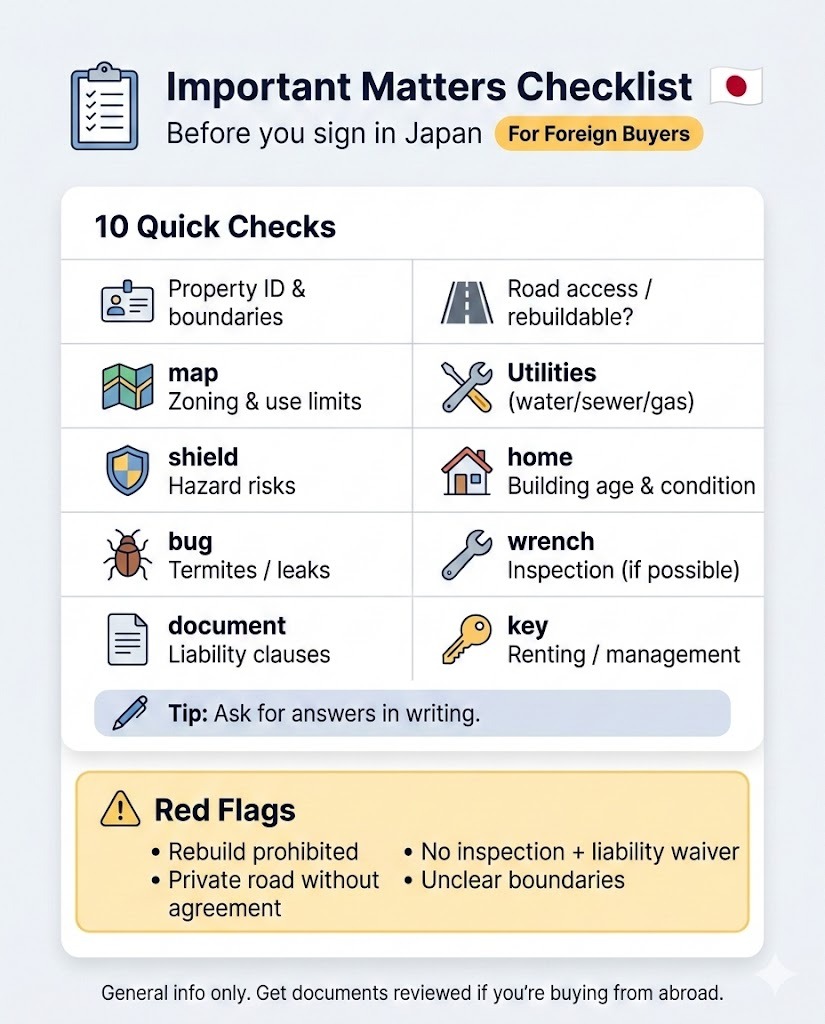
Checklist: What to verify before signing
1) Identity & basic property facts
Confirm these match what you believe you are buying:
Address, lot number(s), and building details
Land category and registered use
Size and boundaries (and whether boundaries are confirmed)
Whether the building is legally registered as a residence
Any unregistered extensions or renovations
Red flag: “The building area in reality differs from registry” or unclear boundary lines.
Internet availability (important for long-term rentals)
Red flag: Expensive upgrades needed for sewer/septic, water piping, or electrical work.
5) Disaster & hazard risks
Look for:
Flood risk areas (flood map zones)
Landslide warning zones
Earthquake and liquefaction notes
Coastal risks if relevant
Past disaster history (if stated)
Tip: Hazard risk doesn’t always mean “don’t buy,” but it should affect price, insurance, and renovation plans.
6) Defects, repairs, and “hidden issues”
Check the sections about:
Known defects (leaks, termites, structural issues)
Past repairs and renovation records
Whether a building inspection was done
Whether the seller discloses any issues “to the best of their knowledge”
Red flag: No inspection + very old property + vague disclosure language.
7) Psychological stigma (心理的瑕疵) and disclosure
In Japan, certain events can affect buyer perception (for example, death in the property). The document may include related notes if legally required or if the seller/agent knows relevant facts.
Red flag: Evasive language, or the agent refuses to answer direct questions in writing.
8) Seller liability and special clauses
Your contract may limit seller responsibility.
Watch for clauses like:
Seller is exempt from liability for defects
“As-is” sale (現状有姿) with limited remedies
Short deadlines to claim defects
Buyer acknowledges all risks after explanation
Red flag: Liability waiver + no inspection + overseas buyer unable to re-check property.
9) Rental use, long-term leasing, and property management
If you plan to rent out long-term:
Any restrictions on leasing
Whether the building is suitable for tenants (safety, utilities, legality)
If there is a management contract, what the manager is responsible for
Repair approval rules and emergency decision authority while you are abroad
Red flag: Management contract gives broad power without reporting requirements.
10) Minpaku (Airbnb) possibility (if you want the option later)
A common misunderstanding: “I can rent it out” ≠ “I can do Airbnb.”
Check:
Local rules and zoning expectations
Building type and compliance considerations
Whether the area has restrictions for short-term rentals
If the agent makes any promises, get it in writing
Best practice: Treat minpaku as “requires separate confirmation,” not a guarantee.